Plastic Credit Project Development & Advisory Services
Plastic waste is one of the most pressing environmental challenges worldwide. Improper waste management and disposal lead to plastic leakage into the environment, causing significant harm to ecosystems and the lives of living organisms. While various measures have been introduced to address this issue—such as circular economy policies, financial support for environmentally friendly plastic production, and the promotion of waste segregation and recycling—post-consumer plastic waste management remains a major challenge, particularly due to limitations in infrastructure and effective waste management systems.
Plastic credits serve as a financial mechanism that creates economic incentives for plastic collection and recycling projects. Organizations or entities that implement projects aimed at increasing plastic collection or recycling—thereby substituting virgin plastic use and preventing plastic leakage into the environment—may register their projects and seek certification under internationally recognized Plastic Waste Reduction Standards. Certified projects can issue plastic credits based on the additional amount of plastic collected or recycled compared to a baseline scenario in which the project is not implemented.
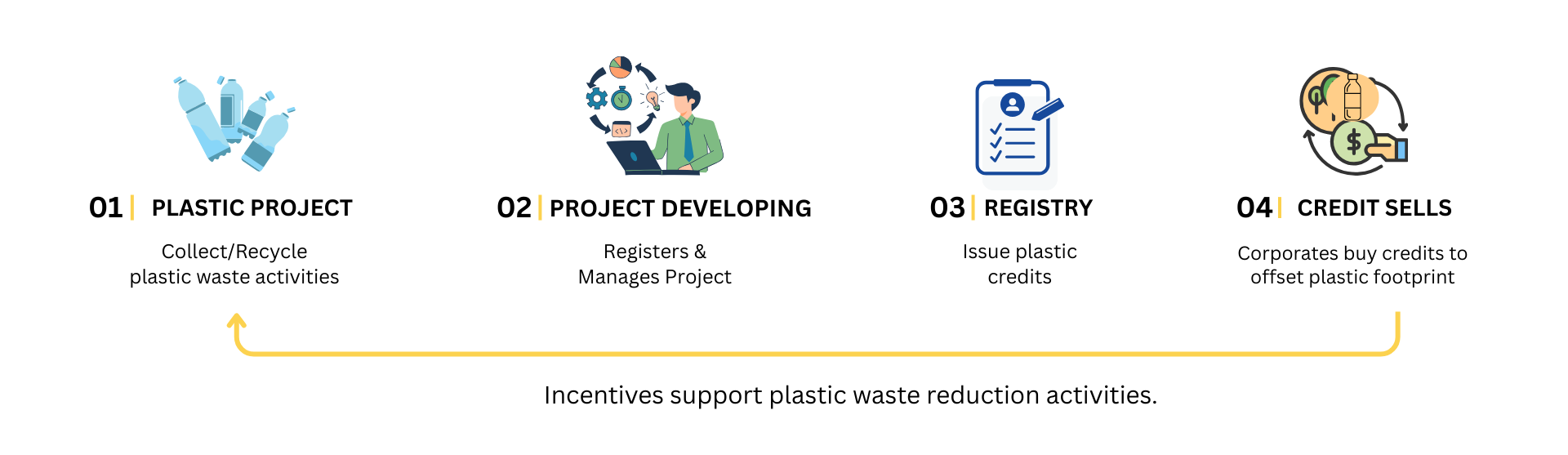
For organizations involved in plastic production or usage that have environmental, sustainability, and corporate social responsibility (CSR) commitments, plastic credits can be used as a tool to offset their plastic footprint. By financially supporting credible, measurable, and independently verified plastic waste reduction projects, organizations can demonstrate accountability and environmental responsibility.
Our Services
Plastic Credit Project Development Advisory
Green & Blue Planet Solutions Co., Ltd. (GBP) provides end-to-end advisory and project development services for plastic credit certification under international standards, such as the Plastic Waste Reduction Standard.
We work closely with project owners engaged in plastic collection or recycling activities, covering the full project lifecycle, including:
- Project feasibility studies for plastic credit certification
- Development of project documentation in line with standard requirements
- Project registration
- Project validation and verification by independent third-party auditors
- Issuance of plastic credits under internationally recognized standards
Plastic Credit Sourcing
GBP supports organizations seeking to purchase high-quality, internationally certified plastic credits to fund transparent and independently verified plastic waste reduction projects. Plastic credits can be used to offset an organization's plastic footprint, support sustainability and environmental targets, and demonstrate corporate responsibility through measurable and credible impact.
Frequently Asked Questions (FAQ)
A: Carbon credits and plastic credits are both market-based environmental instruments, but they address different sustainability challenges.
- Carbon credits help combat climate change by financing projects that reduce or remove greenhouse gas emissions.
- Plastic credits help address plastic pollution by financing projects that collect, recover, and recycle plastic waste.
Many organizations use both instruments as part of a broader sustainability strategy, combining climate action with efforts to reduce plastic pollution and support circular economy initiatives.
Carbon Credits vs. Plastic Credits
Category | Carbon Credits | Plastic Credits |
|---|---|---|
Environmental Issue Addressed | Climate change and global warming | Plastic pollution and waste leakage into the environment |
Visibility | Addresses invisible emissions such as CO₂ and methane | Addresses physical, visible plastic waste |
What is Measured | Greenhouse gas (GHG) emissions reduced, avoided, or removed | Plastic waste collected, recycled, or prevented from entering the environment |
Unit of Measurement | 1 tonne of CO₂ equivalent (tCO₂e) | 1 tonne of plastic waste |
Typical Projects | Reforestation, forest conservation, renewable energy, energy efficiency, carbon removal technologies | Plastic waste collection, ocean-bound plastic recovery, recycling, waste management infrastructure |
Primary Objective | Mitigate climate change by reducing atmospheric greenhouse gases | Reduce plastic pollution and promote a circular economy |
Environmental Impact | Lower greenhouse gas concentrations in the atmosphere | Reduce plastic leakage into land, rivers, and oceans |
Major Standards | Verra (VCS), Gold Standard, ACR, CAR, isometric, puro earth, Rainbow, GCC | Verra (PWRS), PPRS, OBP Certification, Cercarbono |
Verification Process | Third-party verification of GHG emission reductions or removals | Third-party verification of plastic collection and/or recycling activities |
Common Corporate Use Cases | Carbon neutrality, net-zero strategies, Scope 1, 2, and 3 emissions management | Plastic footprint reduction, sustainability commitments, circular economy initiatives |
Key Benefit | Supports climate action and decarbonization | Supports plastic waste management and pollution reduction |
A: There are several plastic credit standards, each with different requirements and certification processes. Examples include the Verra Plastic Waste Reduction Standard (PWRS) and the PCX Solutions Plastic Pollution Reduction Standard (PPRS).
The selection of an appropriate standard depends on factors such as project activities, eligibility requirements, and the target plastic credit market. GBP provides feasibility assessments and advisory support to help organizations select the most suitable standard.
A: Eligible projects are those that aim to reduce plastic waste accumulation in the environment or increase plastic recycling rates. Examples include plastic waste collection systems, landfill plastic recovery projects, and mechanical or chemical recycling initiatives. All projects must comply with the requirements of the selected plastic credit certification standard.
A: Plastic credits are quantified based on the amount of plastic that is properly managed and verified in accordance with the requirements of the applicable standard.
For example, under the Verra Plastic Waste Reduction Standard (PWRS): 1 plastic credit = 1 tonne of plastic waste collected (Waste Collection Credit; WCC) or 1 tonne of plastic waste recycled (Waste Recycling Credit; WRC).